
 NEW LAUNCH
 HIP BAGS
 SLING BAGS
 HAND BAGS
 TOTE BAGS
 CLUTCHES
 SLEEVES & ACCESSORIES
From Waste to Waist: The Journey of Your Dario Lario Bag

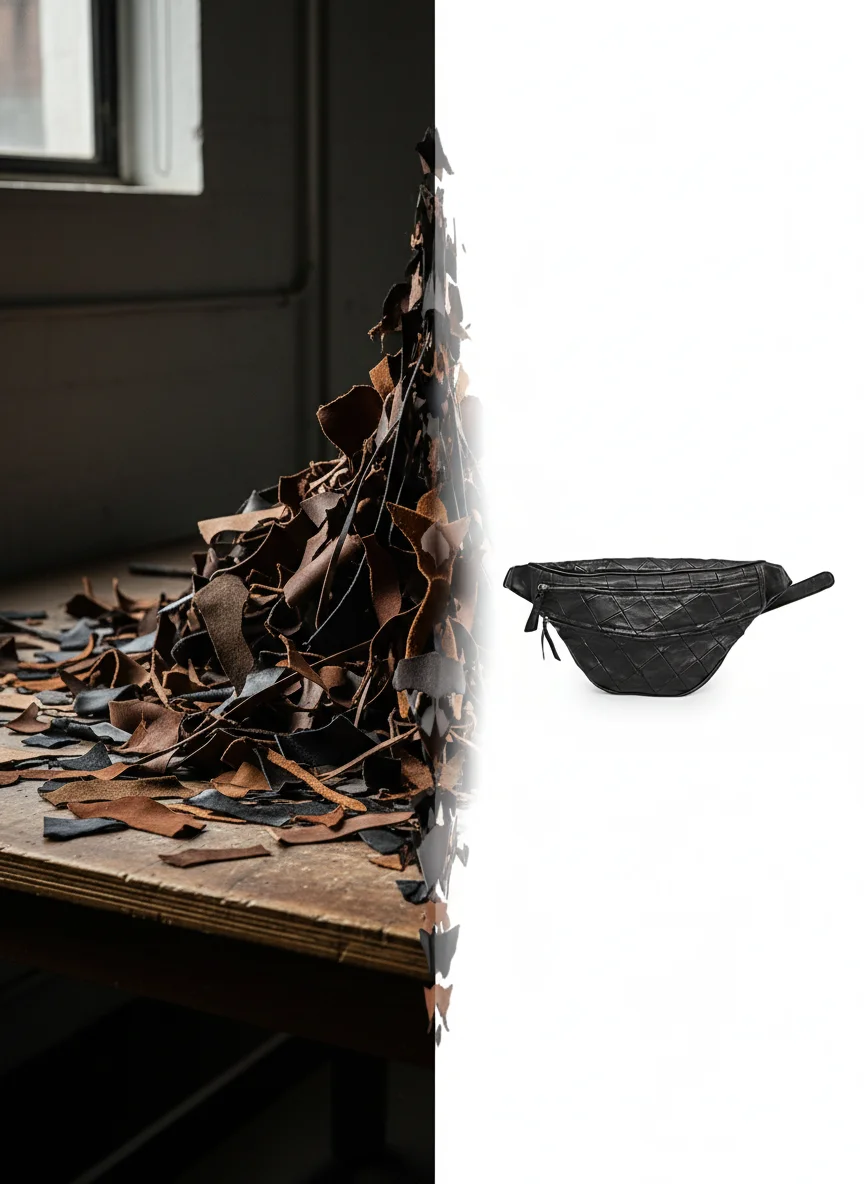
Introduction: Every Bag Has a Story
When you hold a Dario Lario waist bag in your hands, you’re not just holding a fashion accessory—you’re holding a story of transformation, craftsmanship, and purpose. Each belt bag begins its life not as a single piece of premium leather, but as dozens of small patches destined for the waste bin. What happens between “discarded scrap” and “finished product” is a journey of rescue, artistry, and meticulous handwork that spans weeks and involves skilled artisans with decades of experience.
This is the untold story of sustainable leather goods manufacturing—a process that proves luxury and environmental responsibility aren’t mutually exclusive. It’s a journey from waste to waist, from forgotten fragments to functional fashion, from what others discard to what you’ll treasure for years to come.
Welcome behind the scenes.
Chapter 1: The Beginning – Recognizing Value in “Waste”
Where Our Story Starts
Most leather bag manufacturers begin their process by ordering large, perfect hides from tanneries. At Dario Lario, our story starts in a different place entirely: with the materials others have rejected.
The Source:
Our leather journey begins at established manufacturing facilities and tanneries where premium leather goods are produced for global brands. These facilities maintain exacting standards—and that’s where our opportunity lies.
 When a luxury brand orders leather for wallets, handbags, or upholstery, they require:
- Perfectly uniform color across entire hides
- Flawless surface without any natural markings
- Consistent thickness throughout
- Specific grades that meet strict aesthetic standards
The result? Even from the highest quality hides, 20-25% becomes “waste”—not because the leather is inferior in quality or durability, but simply because it doesn’t meet aesthetic perfection standards or doesn’t fit standard cutting patterns.
What Gets Discarded:
- Corner pieces after rectangular patterns are cut
- Strips along hide edges with slight thickness variations
- Sections with minor natural markings or color variation
- Small irregular shapes between pattern pieces
- End-of-roll pieces too small for standard production
The Reality: Most of these “waste” pieces are genuine, high-quality leather with the same durability and character as what becomes luxury products. The only difference? Shape, size, and minor aesthetic variations that make them “unsuitable” for conventional manufacturing.
This is where we step in.
Chapter 2: The Rescue – Sourcing and Selection
Not All Scraps Are Created Equal
Creating a premium waist bag from rescued leather isn’t simply about collecting random scraps. It requires careful sourcing, rigorous selection, and an expert eye for quality.
Step 1: Establishing Partnerships
We work directly with reputable tanneries and manufacturers who share our values:
- Quality Standards: Our partners produce for premium brands, ensuring base material quality
- Ethical Practices: We verify labor conditions and environmental compliance
- Consistent Supply: Long-term relationships ensure reliable material access
- Traceability: We know the origin and processing of every piece
Our 30 years in leather manufacturing means we have established relationships with some of India’s finest leather producers—facilities that supply luxury brands worldwide.
Step 2: The Selection Process
Not every leather scrap makes it into a Dario Lario belt bag. Our quality control begins at the source:
What We Look For:
- ✓ Genuine full-grain or top-grain leather
- ✓ Consistent thickness suitable for bag construction (1.0-1.4mm ideal)
- ✓ Good tensile strength (no weak or damaged areas)
- ✓ Natural leather characteristics (grain, texture, slight color variation)
- ✓ Pieces large enough to be functional (minimum 3×3 inches)
What We Reject:
- ✗ Synthetic or bonded leather
- ✗ Sections with structural damage or tears
- ✗ Pieces treated with incompatible chemicals
- ✗ Material too thin or too thick for waist bag construction
- ✗ Leather with excessive wear or deterioration
The Numbers: From every 100kg of leather scraps we evaluate, approximately 60-70kg meets our quality standards for hip bag and bum bag production. We’re selective because quality cannot be compromised—even in sustainability.
Chapter 3: Preparation – From Random Scraps to Organized Materials
The Art of Categorization
Once we’ve sourced quality leather pieces, the real craft work begins: transforming chaos into order.
 Step 1: Cleaning and Inspection
Every piece of rescued leather undergoes thorough preparation:
- Initial Cleaning: Dust, debris, and residues are removed using specialised leather cleaning solutions
- Detailed Inspection: Each piece is examined for hidden flaws, weak spots, or inconsistencies
- Edge Assessment: Rough or damaged edges are identified for trimming
- Final Quality Check: Pieces are approved or rejected for specific applications
Step 2: Sorting by Characteristics
Our workshop contains an organised system of leather categorisation that would impress any crafts- person:
By Color:
- Deep blacks and charcoals
- Rich cognac and tans
- Dark chocolate browns
- Caramel and honey tones
- Mixed earth tones
By Texture:
- Smooth, fine-grain leather
- Pebbled or textured surfaces
- Natural grain with visible characteristics
- Embossed patterns (like our diamond quilted design)
By Thickness:
- Thin (0.8-1.0mm) – for interior components
- Medium (1.0-1.4mm) – ideal for waist bag body
- Thick (1.4-2.0mm) – for straps and structural elements
By Size:
- Large patches (5″+ square) – primary body pieces
- Medium patches (3-5″ square) – secondary construction
- Small strips – edge binding, detailing
- Long strips – strap components
This categorisation is crucial because creating a cohesive waist bag from diverse pieces requires understanding how they’ll work together.
Chapter 4: Design – Planning the Patchwork
Where Engineering Meets Artistry
Creating a belt bag from rescued leather patches isn’t like conventional bag making. Each product requires individual planning because no two collections of leather pieces are identical.
The Design Challenge:
Traditional bag manufacturing uses templates: cut pattern A from hide B, assemble according to diagram C. Simple, repeatable, efficient.
Our process is different. We must answer:
- Which pieces work together aesthetically?
- How do we arrange patches for visual balance?
- Where do we place seams for maximum strength?
- How do we optimize each irregularly shaped piece?
- Which direction should the leather grain run?
The Design Process:
1. Pattern Selection
We work with several proven waist bag designs optimized for patchwork construction:
- The Classic (gentle curve, moderate size)
- The Urban Explorer (larger capacity, multiple compartments)
- The Minimalist (sleek, compact design)
2. Mock Layout
Before any cutting or stitching, artisans create physical mockups:
- Leather patches are arranged on the pattern template
- Color distribution is evaluated for visual appeal
- Grain direction is checked for consistency
- Structural integrity is assessed
- Adjustments are made until optimal arrangement is achieved
3. Piece-Specific Cutting
Unlike punching out identical patterns, each piece must be hand-cut:
- Patterns are adjusted to maximize use of available leather
- Seam allowances are calculated for each edge
- Hardware placement is marked (zippers, D-rings, adjusters)
- Each piece is numbered to maintain assembly order
The Result: No two Dario Lario waist bags are identical. Even within the same design, leather variations ensure uniqueness. This isn’t a flaw—it’s a feature that luxury consumers increasingly value.
Chapter 5: Assembly – Where Skill Meets Material
The Hands Behind Your Belt Bag
This is where 30 years of leather manufacturing expertise becomes evident. Creating a durable, beautiful waist bag from multiple patches requires skills that take years to develop.
The Artisan Profile:
Our craftspeople aren’t mass-production workers following simple instructions. They’re skilled artisans who:
- Have 10-25 years of leather working experience
- Understand leather behavior, stretch, and characteristics
- Can hand-stitch with precision and strength
- Know how to marry different leather textures seamlessly
- Take pride in their individual craftsmanship
Step 1: Edge Preparation
Before pieces can be joined, edges must be prepared:
- Skiving: Gradually thinning leather edges to reduce bulk at seams
- Burnishing: Smoothing and sealing cut edges for finished appearance
- Adhesive Application: Strategic use of leather cement for preliminary bonding
Step 2: Stitching – The Critical Phase
This is where rescued leather becomes a cohesive product.
Saddle Stitching Technique: We use traditional saddle stitching for critical seams—a hand-sewing technique that:
- Creates stronger bonds than machine stitching
- Allows control over tension and placement
- Accommodates thickness variations between patches
- Produces authentic, artisanal aesthetic
- Ensures longevity (properly saddle-stitched leather can last 50+ years)
The Process:
- Two needles work simultaneously from opposite sides
- Waxed thread passes through pre-punched holes
- Each stitch is pulled tight with equal tension
- Pattern maintains exact spacing (typically 6-8 stitches per inch)
- Critical stress points receive reinforcement stitching
Machine Stitching: For certain seams, industrial machines provide consistency:
- Straight seams on larger patches
- Zipper installation
- Strap attachment points
- Binding application
 The Balance: Combining hand and machine techniques maximizes both quality and efficiency while maintaining the artisanal character.
Step 3: Hardware Installation
A waist bag isn’t complete without functional hardware:
Zipper Integration:
- YKK or equivalent quality zippers (we never compromise here)
- Carefully installed to handle daily use stress
- Leather zipper pulls adding premium touch
- Reinforced stitching at high-stress points
Strap Systems:
- D-rings or sliding adjusters for length customization
- Rivets or bar-tack reinforcement at attachment points
- Webbing or leather straps (depending on design)
Buckles and Adjusters:
- Antique brass, gunmetal, or silver-tone finishes
- Smooth operation without catching or snagging
- Secure attachment preventing accidental release
Step 4: Lining Installation (when applicable)
Some designs include interior lining:
- Durable fabric or soft leather lining
- Interior pockets for organisation
- Clean finish hiding construction seams
- Additional protection for contents
Chapter 6: Quality Control – Ensuring Excellence
Every Bag Earns Its Place
Before any hip bag or bum bag leaves our workshop, it undergoes rigorous quality control—the same standards we’ve applied to products for luxury brands over three decades.
The 15-Point Inspection:
- Structural Integrity: All seams tested for strength

- Stitch Quality: No loose threads, consistent spacing
- Leather Condition: Surface checked for damage or flaws
- Color Consistency: Aesthetic appeal of patch arrangement
- Hardware Function: Zippers, buckles, adjusters tested
- Strap Security: Attachment points load-tested
- Shape and Form: Product maintains intended silhouette
- Edge Finishing: All edges properly treated and sealed
- Interior Condition: No exposed rough edges or adhesive
- Zipper Alignment: Smooth operation without catching
- Dimensions: Meets design specifications
- Weight Balance: Hangs properly when worn
- Odor Check: Pleasant leather scent, no chemical smell
- Overall Appearance: Meets aesthetic standards
- Brand Standards: Worthy of the Dario Lario name
The Standards:
- Rejection rate: approximately 8-12% of assembled bags don’t pass inspection
- Rejected bags are disassembled, and quality materials are repurposed
- Nothing leaves our workshop unless it meets luxury standards
- We stand behind every product with warranty and repair commitment
Load Testing: Selected samples undergo stress testing:
- Filled with 5kg weight and subjected to motion simulation
- Strap attachment points tested to 20kg pull force
- Zippers operated 500+ times
- Water resistance evaluated
The Promise: When you receive your Dario Lario waist bag, you can trust it’s been thoroughly vetted by craftspeople who put their reputation into every stitch.
Chapter 7: Finishing Touches – From Workshop to Wardrobe
The Final Details Matter
The journey from waste to waist is nearly complete, but the finishing phase determines how your belt bag will look, feel, and perform.
Step 1: Surface Treatment
Depending on leather type and design:
- Conditioning: Leather is treated with conditioning oils to enhance suppleness
- Protection: Water-repellent coatings applied when appropriate
- Polishing: Smooth leathers receive gentle buffing for subtle sheen
- Final Cleaning: Any workshop residue or fingerprints removed
Step 2: Brand Elements
Your bag receives its identity:
- Logo Embossing or Stamping: Discreet Dario Lario branding
- Interior Labels: Material information and care instructions
- Serial Numbers: Each bag is individually numbered for authenticity
- Hang Tags: Telling the rescued leather story
Step 3: Packaging – The Unboxing Experience
We believe sustainable products deserve beautiful presentation:
Dust Bag:
- Breathable fabric storage bag
- Protects during storage and travel
- Reusable and eco-friendly
 Care Card:
- Leather maintenance instructions
- Cleaning recommendations
- Warranty information
- Brand story overview
Packaging Materials:
- Recyclable or recycled cardboard boxes
- Minimal plastic usage
- Biodegradable filling materials when needed
- Seed paper inserts (can be planted!)
Step 4: Documentation
Each waist bag comes with:
- Certificate of authenticity
- Unique product ID
- Approximate number of leather patches used
- Care and maintenance guide
- Warranty registration
Conclusion: More Than a Bag
Your Decision Matters
The journey from waste to waist—from discarded leather scraps to the premium belt bag on your hip—is more than a manufacturing process. It’s a statement about what we value, how we consume, and the future we’re creating.
Every time you wear your Dario Lario waist bag, you’re making a statement:
“I choose quality over quantity.” “I value craftsmanship and artisan skills.” “I believe fashion and sustainability can coexist.” “I appreciate uniqueness over uniformity.” “I’m willing to pay for what matters.”
In a world of fast fashion, disposable products, and planned obsolescence, choosing a handmade, rescued-leather hip bag or bum bag is a quiet rebellion. It’s a vote for a different way of making, consuming, and living.
The journey doesn’t end when you receive your bag—it’s just beginning. As you wear it daily, take it on adventures, and watch it develop character, you’re adding your own chapter to its story. The leather patches that might have ended up in a landfill are instead accompanying you through life, becoming part of your story.
That transformation—from waste to waist, from discarded to cherished, from forgotten to forever—is the real magic of what we do.
And now you know exactly how it happens.
Join the Journey
Ready to own a piece of transformed leather with a story to tell?
Shop the look
Handcrafted hip bags with a story to tell.


The Black Leather Patchwork Hip Bag – Dual Zip Minimalist Edition
Original price was: ₹7,773.52.₹6,909.70Current price is: ₹6,909.70.*incl. of all taxes. Free shipping (UK & US only)


Vintage Brown Patchwork Leather (Patina) Hip Bag – Premium Handmade Belt Bag
Original price was: ₹8,637.34.₹8,119.04Current price is: ₹8,119.04.*incl. of all taxes. Free shipping (UK & US only)


Dario Lario Studded Brown Patina Leather Hip Bag – Premium Crossbody Waist Pack
Original price was: ₹8,637.34.₹8,119.04Current price is: ₹8,119.04.*incl. of all taxes. Free shipping (UK & US only)
popular steroid
References:
https://www.instapaper.com/p/17437579